Article: How Should a Dress Shirt Fit? Collar, Shoulders, Sleeves, Waist and Sizing Explained
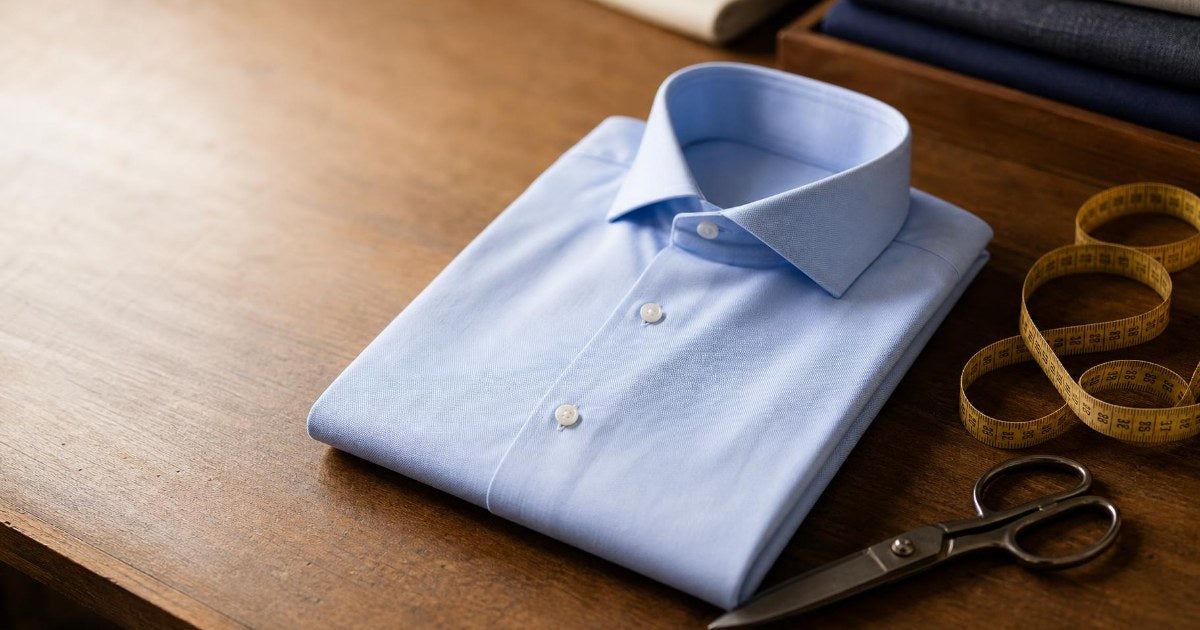
How Should a Dress Shirt Fit? Collar, Shoulders, Sleeves, Waist and Sizing Explained
People often ask how a dress shirt should fit, and the answer comes down to six checkpoints. Run through them in front of a mirror and you will know within a minute whether a shirt works.
- Collar: it touches the neck all the way round without pressing into it.
- Shoulders: the seam lands at the edge of the shoulder bone.
- Chest and waist: the body follows your torso, with no pulling at the buttons and no billowing above the belt.
- Sleeves and cuffs: the cuff ends at the base of the thumb and stays snug at the wrist.
- Length: the tail stays tucked when you raise your arms or sit down.
- Overall movement: you can reach, bend and sit without the fabric fighting you.
Fit matters more on a shirt than on most garments. It sits closest to your face, and it is often the only layer on show once the jacket comes off. The sections below take each checkpoint in turn, then cover sizing and the main cuts.
Collar Fit: How Tight Should It Be?
A well-fitted collar touches your neck all the way round when the top button is fastened. No gap opens at the sides, and there is enough room to swallow and turn your head without any pressure.
Too tight shows up quickly. The skin pinches above the collar, the button strains, and the neck pushes up over the collar's edge. Too loose shows as a gap between collar and neck, and the collar points drift away from the chest and wander under a tie knot.
The usual advice is the finger test: slide one or two fingers between your neck and the collar. Advice differs on one finger or two, because a neck flexes as you move and a heavier fabric sits differently from a light one. The finger test works as a quick check in the fitting room, and a tape measure gives the more reliable answer. Measure your neck once, buy to that number, and the guesswork goes away.
Comfort is one reason to get this right. In a study of 94 white-collar working men, 67% were wearing neckwear tighter than their neck circumference, and a tight collar and tie combination reduced visual performance on a flicker test. If a collar pinches, go up a size.
Collar shape frames the face as well. A spread collar, with its points set wide apart, suits a longer or narrower face and leaves room for a fuller tie knot. A point collar, with its points set closer together, adds a vertical line that suits a rounder face. Both look their best when the collar fits the neck first.
Shoulders and Armholes
The shoulder seam, where the sleeve joins the body, should land at the edge of the shoulder bone, right where the shoulder meets the arm. Stand square to a mirror and check both sides.
A seam that slides down the upper arm means the shirt is too big through the shoulders. The sleeve droops, fabric bunches under the arm, and the whole shirt looks borrowed. A seam that rides toward the neck means the shirt is too small, and the shoulders feel pinched when you reach forward. Shoulders cannot be enlarged or reshaped easily, so this checkpoint tells you early whether a shirt is worth pursuing.
The armhole carries as much weight as the seam. A cut that is high and snug under the arm lets you lift your arms without dragging the body of the shirt up with them. A low, loose armhole feels roomy while you stand still, and then the shirt pulls out of your trousers as soon as your arms go overhead.
Raise both arms to about 45 degrees. The hem should stay close to where it started, the sleeves should move freely, and the collar should sit where it was. A shirt that passes this check in the fitting room will keep passing it at your desk, at dinner and on the dance floor.
Chest, Waist and Hips
The body of the shirt should follow your torso. Fastened, the buttons lie flat across the chest with no gaps between them. Tucked in, the fabric sits smoothly above the belt and does not billow over it.
The pinch test at the sides tells you how much room there is. Take a fold of fabric at each side of your waist. Two to three inches of loose fabric on each side is a clean fit. More than that leaves excess that will bunch when you tuck in, and less means the shirt is snug enough to strain when you sit.
Back darts are two small folds sewn vertically into the back of the shirt. They take in the waist so the fabric follows the curve of your lower back instead of ballooning there. A shirt with darts gives a cleaner shape through the middle, and it suits men whose chest is noticeably wider than the waist.
Check the hips and seat as well. Sit down and look at the lower buttons. If the fabric pulls into small X shapes around them, the shirt needs more room below the waist.
A tailor can change some things and not others. The waist can be taken in, usually at the side seams or with added darts, and a hem that runs long is easy to shorten. A collar, a shoulder or a sleeve that is too short cannot be enlarged, because a shirt carries very little spare seam allowance. Choose the shirt that fits your collar and shoulders, and let the waist be adjusted afterwards. Cut also decides how much room the body has, and the section on slim fit vs regular fit dress shirts further down covers each one.
Sleeves and Cuffs
Stand with your arms relaxed at your sides. The cuff should end at the base of your thumb, where the wrist meets the hand. A sleeve that stops short exposes the wrist bone, and a sleeve that runs long collapses over the hand.
Under a jacket, about half an inch of shirt cuff should show beyond the jacket sleeve. That small band of fabric frames the hand and keeps the jacket cuff from rubbing the skin. It only works when the shirt sleeve is the right length to begin with.
Look at the shape of the sleeve as well. It should taper evenly from the upper arm to the wrist. Extra fabric that folds or ripples along the forearm means the sleeve is too wide for your arm, and a sleeve that grips the bicep when you bend your elbow is too narrow.
The cuff itself should be snug enough that it does not slide over your hand when you reach. It also needs room for a watch. Fasten the button, slip the watch on, and check that the cuff closes without squeezing the wrist and that the watch face stays visible when you move your arm.
French cuffs fold back on themselves and close with cufflinks. They feel a little bulkier at the wrist than a button cuff, and they look more formal. The same checks apply: the folded edge should end at the base of the thumb, and the cuff should sit close enough that it stays put.
Shirt Length: Tucked and Untucked
A dress shirt meant to be tucked in needs a tail long enough to stay in place. Tuck it in, then raise your arms overhead and sit down. If the shirt stays tucked through both, the length is right.
The tail should reach over the back pockets of your trousers. That length covers the seat and gives the fabric enough to stay put as you move. A tail that stops short of the pockets comes out the moment you bend. A tail that hangs far below them bunches under the belt and adds bulk at the waist, and a long hem is easy for a tailor to shorten.
Shirts cut to be worn untucked follow different rules. They have a shorter, even hem that ends around the middle of the fly. That length sits neatly over the belt line without dipping low at the sides, and it keeps the shirt from swallowing the hips. Wear one tucked and it tends to pop out, so check the label or the shape of the hem before you decide how it will be worn.
How to Measure Your Dress Shirt Size
Dress shirt sizes look like code until you know the two body measurements behind them. The first is your neck. Wrap a soft tape around the base of your neck, where a collar would sit, and keep it snug without pulling it tight. The second is your sleeve. Start at the centre of the back of your neck, run the tape over the shoulder and down to the wrist, with your arm slightly bent.
Those two numbers make up the label. A size such as 15.5 / 34-35 reads as a 15.5 inch neck and a sleeve length of 34 to 35 inches. Lettered sizes such as S, M and L group a span of neck sizes under one letter, and they relate to chest as well as neck. Sizing standards name neck girth or chest girth as the main body measurement for men's shirts, with arm length as a secondary one.
The same number can fit differently from one brand to the next. A size label describes the body a shirt is meant for, and each brand sets its own garment measurements and allowances, so different companies' sizes can fit the same body in different ways. Treat a size as a starting point and try the shirt on.
For a cross-check, measure the collar of a shirt that already fits you. Button it, lay it flat, and measure from the centre of the button to the far end of the buttonhole. That number should match your neck measurement closely.
When you land between sizes, let the collar and shoulders decide. These are the parts a tailor cannot enlarge, so pick the size that fits them and take in the waist if the body runs roomy. If the sleeve falls between two lengths, take the longer one, since a sleeve can be shortened and cannot be lengthened. Cotton also relaxes and settles after its first wash, so allow for a little give in a crisp new shirt.
Slim Fit vs Regular Fit Dress Shirts
Each cut describes how much fabric sits around the body, and the differences show up in four places: the chest, the waist, the armhole and the sleeve.
A slim fit tapers from the chest to the waist, with a higher armhole and a narrower sleeve. It follows the body closely and suits lean or athletic builds, where the drop from chest to waist is clear. A modern or regular fit is the middle ground. It keeps a gentle taper and adds more room through the chest and waist, which suits most average builds. A classic fit is full through the body and the sleeve, and it suits men who want space to move, including those with a broader chest or a fuller midsection. A skinny fit is the closest cut of all, narrow through the sleeve and the body, and it works best on slender frames.
Fabric changes how a cut feels. A slim cut in stretch fabric gives with your movement, so it feels easier to wear than the same cut in a rigid cotton. That makes stretch a good match for anyone who likes a slimmer look but wants comfort at the desk or on the dance floor.
At Mango's, the dress shirt range runs from slim through modern fits, and the collection includes stretch styles such as the SELECTED Slim Fit Stretch Shirt. If you are unsure which cut belongs on your frame, try one of each side by side. The mirror shows the difference quickly, and the movement test below confirms it.
The Movement Test: Signs a Shirt Doesn't Fit
A fitting-room routine shows more than standing still ever will. Button the shirt fully, including the collar and cuffs. Raise your arms, reach forward as if you were shaking a hand across a table, sit down, and bend your elbow. Check what moves each time.
Then read the wrinkles. X-shaped pulling lines around the buttons mean the shirt is too tight across that part of the body. Pooling fabric, especially at the back or at the sides of the waist, means it is too loose. If the cuff climbs more than about an inch up your wrist when you bend your elbow, the sleeve is too short. A shirt that comes untucked when you lift your arms points to the armhole, which may be cut too low or too loose.
Collars and shoulders also report back during the routine. A collar that gapes or shifts as you turn your head needs a smaller size, and a shoulder seam that creeps toward your neck when you reach forward needs a larger one.
Bodies are rarely symmetrical, so one shoulder sits a little higher or one arm runs slightly longer. A small wrinkle on one side is normal on an off-the-rack shirt. A pattern that repeats on both sides tells you the fit needs a change.
Finding Your Fit at Mango's
Mango's Menswear has been downtown Victoria's menswear destination since 2005, with a dress shirt wall of over 100 styles from AuNoir, Bugatchi, Maceoo, Michael Kors, BYLT Basics, NZA New Zealand Auckland and G-Star RAW, in fits from slim through modern. Our team sizes customers in person so the collar and sleeve sit right the first time, and every shirt on the dress shirt collection page is in the store at 577 Johnson Street to try on. Online orders in Victoria ship free the same day.
If you would like a hand choosing a size or a cut, send your question through the Contact Us page and the team will help you find a shirt that fits.

